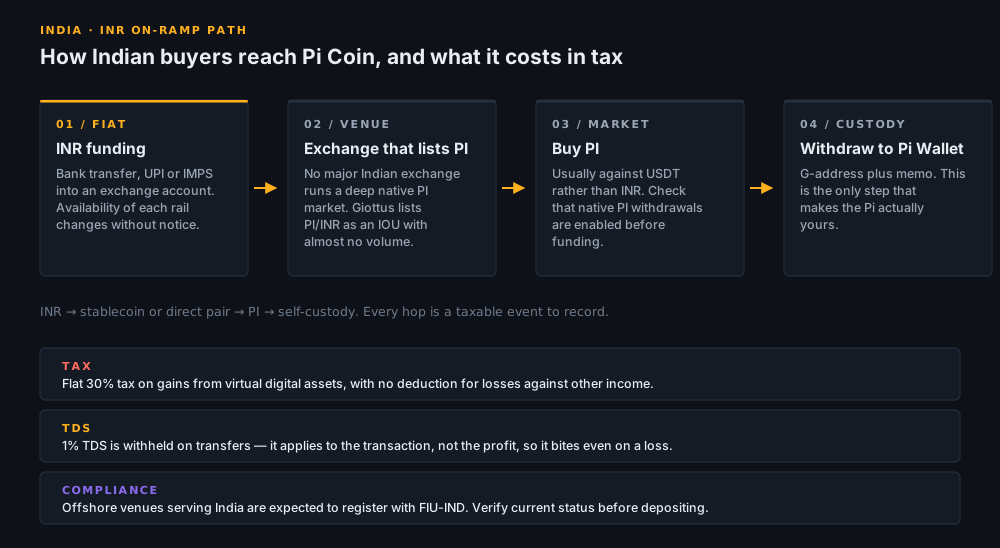
If you searched for how to buy Pi Coin in India expecting a list of exchanges, the useful answer is worse than that and almost nobody has written it down. As of 27 July 2026, all four offshore exchanges that list PI are impaired for Indian users. MEXC suspended services for existing India users from 28 February 2026 and delisted INR from its P2P market the day before. Bitget closed new India sign-ups on 6 February 2026. Gate.io has been blocked by MeitY since 10 December 2024. OKX exited India in April 2024 and we could not verify that it has returned.
Now the mirror image of that. The two offshore venues that did register with FIU-IND and came back to India — Binance and KuCoin — have zero PI markets. We queried their own public endpoints: Binance returned no PI among 3,659 symbols, and KuCoin's currency endpoint answers "PI currency does not exist". So FIU-compliant offshore access, the thing Indian coverage treats as the solution, does not give you Pi at all.
What is left is two domestic venues, one thin and one unverifiable, plus a tax regime that charges 30% on gains and refuses to recognise losses. That combination is the whole story, and the rest of this page is the detail: which venues, at what price, with what rails, and what the Income-tax Act does to the outcome. For the global picture of venues and pairs, see our where to buy Pi Coin map and the venue-by-venue Pi Coin exchange audit.
The route you wanted is probably closed
For most Indian readers the correct answer to "which exchange should I use" is that the one you had in mind no longer serves you. That is not a satisfying conclusion, so it is worth being precise about how each door shut, because the reasons differ and so do the consequences.
Where these numbers come from
Listing status was read from each exchange's own public REST endpoint on 27 July 2026 — CoinDCX, WazirX, ZebPay, Giottus, Binance, KuCoin and the rest — which is the same configuration that drives their live trading and withdrawal screens. India access dates come from the exchanges' own announcements and support pages. Tax provisions are quoted from the Income-tax Department's published section text at incometaxindia.gov.in; note that site returns 403 to automated fetches, so the verbatim wording comes from indexed copies of those official pages rather than a live retrieval. Budget 2026 changes are sourced to reporting dated 2 February 2026.
How each offshore venue shut India out
Four exchanges list native PI and once served Indian users. Each is now unavailable, and none of the four closures had anything to do with Pi.
-
Apr 2024
OKX leaves India by choice
OKX announced on 21 March 2024 that it would cease Indian operations, requiring users to withdraw by 30 April 2024. Whether OKX has since returned is unverified — we could not settle it either way, so do not assume either direction. OKX runs the deepest KYB-verified PI book anywhere, which makes this the costliest of the four closures.
-
10 Dec 2024
Gate.io blocked at the network level
MeitY blocked gate.io under the Information Technology Act 2000, and India appears among Gate's restricted locations in its user agreement. That page returns 403 to automated fetches, so we could not capture the verbatim clause.
-
6 Feb 2026
Bitget stops new Indian onboarding
Per Bitget's own support page, new onboarding for India residents and Indian KYC ended at 16:00 IST on Friday 6 February 2026. Existing verified accounts keep trading, deposits and withdrawals. Bitget framed it as a procedural step to align with India's AML and reporting framework under the FIU. Worth flagging: a separate Bitget marketing page claims the exchange "has secured FIU-IND status", which is inconsistent with its own support notice. Treat the marketing claim as unverified.
-
27–28 Feb 2026
MEXC suspends existing Indian users
Announced 15 January 2026: services for existing India users suspended from 00:00 IST on 28 February 2026, with INR delisted from MEXC P2P effective 27 February 2026. MEXC's stated reason was completing FIU-IND registration. MEXC ran four PI quote pairs, so this removed more PI liquidity from Indian reach than any other single event.
Add the two returnees and the picture completes. KuCoin registered with FIU-IND in March 2024 and paid a penalty. Binance registered during 2024 — sources disagree on whether it was May or August — and FIU-IND's own published order, number 10/DIR/FIU-IND/2024 dated 19 June 2024, imposed a penalty of ₹18,82,00,000 under section 13 of the PMLA. Both are back. Neither lists PI. Since Binance has no INR spot pair either, its P2P market is not a Pi route for Indian users under any configuration.
The two domestic options, examined
Only one Indian exchange has a PI market we could verify independently, and one more claims to. Everything else on the usual list of Indian platforms has no PI at all, and we checked that against their own APIs rather than against their marketing.
| Exchange | PI market | Basis, and what to know |
|---|---|---|
| Giottus | PI/INR live | Its own ticker API returns piinr as {name: "PI/INR", type: "SPOT"}, and its 20 February 2025 announcement claims it was among the first Indian exchanges to list PI, with INR in via UPI, IMPS and NEFT. Same post: "Deposits and withdrawals will be available soon." See the liquidity check below. |
| Flitpay | Self-reported | Claims to list PI since 20 February 2025 and to be "the only exchange in India to enable Pi coin deposits and list Pi coin", with zero deposit fees. There is no public API, so we could not verify any of it — and the "only exchange" claim is directly contradicted by Giottus. Treat as unconfirmed. |
| CoinDCX | No | Zero PI pairs among 1,014 markets in its own markets endpoint. Its "how to buy pi-coin" page is written in the conditional — a forward-looking SEO page, not a listing. This is the single most common false positive in Indian Pi search results. |
| CoinSwitch | No | CoinSwitch says so itself, in an article dated 21 April 2026: "As of now, Pi coin is not listed on CoinSwitch." Its Web3 section does list a Solana pump.fun token named "Pi NetWork" — an impostor with no connection to Pi Network. |
| WazirX | No | Zero PI among 500 tickers. Trading resumed 24 October 2025 after the July 2024 hack and a Singapore court-approved restructuring, which is a real story and irrelevant here: there is no PI market either way. |
| ZebPay | No | Zero PI among 515 pairs in its public market endpoint. |
| Mudrex | No | Its /buy-pi path returns the generic homepage, and its own explainer states that Pi coins cannot be bought from any online platform in India, directing readers offshore. That advice is now stale, for the reasons in the section above. |
| Bitbns | Not established | Its public API endpoints returned 404 and 401, so we could not test. Secondary sources report no PI listing. We are not going to state a status we did not verify. |
Giottus: a real market you probably cannot use at size
Verifying the listing is the easy part. Pricing it is where the problem shows. On 27 July 2026 the Giottus PI/INR book showed a last trade of ₹9.44, a bid of ₹8.101 and an ask of ₹8.605, on 24-hour volume of 1,364 PI. Against a global price of about $0.082, roughly ₹7.2, that is a bid-ask spread near 6% and a premium of roughly 17% to 31% depending on which side you take, on a book turning over about ₹11,000 a day.
Eleven thousand rupees a day is not a market you can exit through. A single retail order of any seriousness is the whole book. There is also a classification contradiction: Giottus's own API reports the pair as type: "SPOT", while CoinGecko classifies the same market as an IOU with about $134 of daily volume. Both sides are recorded here because we cannot resolve them, and the implication is significant — an IOU cannot be withdrawn to the Pi blockchain. The exchange's own launch post saying deposits and withdrawals would come "soon" tilts the reading towards CoinGecko rather than towards the API label.
A premium plus a spread plus a 30% tax is a hard start
Buying at the Giottus ask on 27 July 2026 meant paying roughly a fifth to a third more than the global reference price. You would need the global price to rise by that premium before breaking even, and if it falls instead, India's tax code gives you nothing for the loss — no set-off, no carry-forward. Meanwhile 1% is withheld at source regardless of whether you made money. That is not a prediction. It is arithmetic about spreads and statute.
Affiliate disclosure: the two buttons above open a third-party exchange in a new tab and are tagged nofollow sponsored. We may earn a commission at no extra cost to you. This is not the official Pi Network app, the official Pi Wallet, or an endorsement — and the PI instrument sold there is an IOU, not native mainnet Pi. Nothing here is financial advice.
How to buy Pi Coin in India, step by step
This is written for the reader who has weighed the above and still wants to proceed. Work through it in order; steps one and six are the ones that decide whether you end up holding Pi or holding a database row.
-
Check whether you can reach a venue at all
Before uploading a PAN card anywhere, establish eligibility. If you hold an existing verified Bitget account, it still trades PI/USDT with deposits and withdrawals per Bitget's own notice. If you do not, you cannot open one from India. MEXC is suspended for existing users too, Gate is network-blocked, and OKX's status is unverified. Binance and KuCoin are reachable and have no PI. That leaves domestic venues.
-
Choose between a domestic INR market and an offshore account you already have
Giottus is the only Indian venue with an independently verifiable PI/INR market. Flitpay claims one and cannot be checked. An existing Bitget account gives you a deeper USDT book but requires you to acquire USDT first, which is itself a taxable VDA-to-VDA transfer under Indian law. Decide which cost you prefer: the domestic premium, or a second taxable leg.
-
Fund the account in rupees
Giottus names UPI, IMPS and NEFT for INR deposits in its own PI announcement. We found no RBI circular or NPCI directive prohibiting UPI payments to crypto exchanges, but availability genuinely varies by bank and by UPI app — Indian exchanges blocked UPI deposits in April 2022 after NPCI publicly distanced itself, and residual bank-level friction persists. Use a small first deposit to find out whether your bank cooperates.
-
Price the order against the global reference, not the local screen
Open an aggregator, convert the global PI price into rupees, and compare it against the ask you are being shown. If the gap is a fifth or more, you are paying for the absence of competition, not for Pi. Our Pi Coin price record explains why the global figure itself varies between aggregators by more than you would expect.
-
Size the order to the book
Use a limit order, never a market order, on a book this size. Place a fraction of your intended amount and watch what it does to the spread. If your test order visibly moves the price, your full order will move it further, and the slippage will exceed every fee on the page combined.
-
Test the withdrawal rail before you buy any size
A PI market is not a PI rail. Across the whole global venue set, only five exchanges published a working two-way native PI rail in their own APIs as of 27 July 2026: Kraken, OKX, Bitget, Gate and LBank. If the venue cannot show you a PI withdrawal screen with a
G…address field and a quoted fee, assume the balance is an internal claim. Withdraw the smallest permitted amount and confirm it lands on-chain. -
Move the balance into a self-custody Pi Wallet
Create the wallet only inside the Pi Browser app. The passphrase is generated on your device, never reaches Pi's servers, and cannot be reset by anyone. Read our Pi Wallet guide before you generate it, and the buying and selling walkthrough for the mechanics of the transfer itself.
-
Write the transaction down for Schedule VDA
Record the date, quantity, cost of acquisition in rupees, consideration received, and any TDS deducted, for every single transaction. Schedule VDA in ITR-2 or ITR-3 is filed transaction-wise, not as an annual total, and no expense other than cost of acquisition is deductible. Do this as you go; reconstructing it in July is how people misfile.
There is no second Pi network, and the memo rule depends on the address
Pi is not an EVM chain. It has no contract address, no bridge and no wrapped version on its own mainnet, so any withdrawal dropdown offering you "PI" on BNB Smart Chain, Ethereum or Polygon is offering an unaffiliated token with the same name. XT.COM's live withdrawal config exposes three such wrapped chains beside native PI. Kraken's listing notice states the consequence flatly: deposits made using other networks will be lost.
On memos, both blanket rules are wrong. A memo is required when the venue gives you a G… address, and not required when it gives you a muxed M… address, which carries the routing identifier inside the address itself. Kraken documents exactly that distinction. Read the field on the screen in front of you. A deposit missing a required memo lands in the exchange's pooled account with nothing to attribute it to, and recovery then depends entirely on a support queue.
And the self-custody step itself: your Pi Wallet passphrase is only ever entered at wallet.pinet.com inside the Pi Browser. Pi Network's own rule. Anything else asking for it is a theft in progress, whatever it calls itself.
Tax: 30% flat and 1% TDS, precisely
India taxes crypto more bluntly than almost anywhere, and the details matter more for a token down 97% than for one that went up. This section is factual research, not tax advice. Take it to a chartered accountant before you file anything.
| Item | Provision | What it means for a PI holder |
|---|---|---|
| Flat rate | Section 115BBH | 30% on income from transferring a VDA, plus applicable surcharge and 4% cess. No slab benefit, no basic exemption applied to it. |
| Deductions | Section 115BBH | Computed "without deduction of any expenditure (other than the cost of acquisition, if any)". Exchange fees, the spread you crossed, and transfer fees are all non-deductible. |
| Losses | Section 115BBH | No "allowance or set-off of any loss", between VDAs or against other income, and no carry-forward. This is the provision that matters most to Pi holders. |
| TDS | Section 194S | 1% deducted at source on the payment for a VDA transfer, in force since 1 July 2022. It applies to the transaction, not the profit. |
| TDS thresholds | Section 194S | ₹50,000 per financial year for "specified persons" — individuals or HUFs with no business income, or business turnover up to ₹1 crore. ₹10,000 for everyone else. |
| Filing | Schedule VDA | Transaction-wise disclosure in ITR-2 or ITR-3. TDS is reported through Form 26QE for specified persons, Form 26Q otherwise. |
| Scope | Finance Act 2025 | The VDA definition was widened to cover "any crypto-asset being a digital representation of value that relies on a cryptographically secured distributed ledger". That plainly captures PI. |
| Reporting penalties | From 1 Apr 2026 | ₹200 per day for failure to furnish prescribed statements, plus a flat ₹50,000 for incorrect or uncorrected information. These fall on reporting entities, not directly on you. |
Budget 2026, presented on 1 February 2026, retained the 30% rate and the 1% TDS unchanged despite sustained industry lobbying. What changed on 1 April 2026 was numbering and enforcement, not substance: the Income-tax Act 2025 renumbers the provisions — the 30% charge moving into Section 194's table and TDS consolidating into Section 393 — while preserving the no-carry-forward rule and the cost-of-acquisition-only rule. The specific VDA nature code under Section 393 is something we could not confirm on a primary page.
Now the sharp point, which is the single most consequential tax fact for an Indian Pi holder and almost never stated plainly. Because there is no loss set-off and no carry-forward, an Indian holder sitting on PI down roughly 97% from its all-time high cannot use that loss against anything. Not against a gain on another token. Not against salary or business income. Not against next year. The 30% applies fully when you win and the loss is worth precisely zero when you lose. That asymmetry belongs in the decision before the price chart does.
Legal status, FIU-IND and two corrections
Trading crypto in India is legal and crypto is not legal tender. The Reserve Bank of India's banking ban was struck down by the Supreme Court in 2020 in Internet and Mobile Association of India v. RBI, and nothing has reinstated it.
The most authoritative current statement is very recent. The Parliamentary Standing Committee on Finance's 36th report on the Securities Markets Code, 2025, tabled on 23 July 2026 under chair Bhartruhari Mahtab, records the Ministry of Finance position that virtual digital assets are "presently unregulated in India, except for the limited purposes of taxation, prevention of money laundering and reporting." The panel recommended an interim framework through self-regulatory organisations under SEBI or RBI oversight. That is a recommendation in a committee report: advisory only, and nothing changed operationally.
Two corrections to claims that circulate widely in Indian crypto content.
- The December 2023 FIU-IND show-cause list did not include OKX or Bitget. The nine exchanges named in the notices issued on 28 December 2023 under section 13 of the PMLA 2002 were Binance, KuCoin, Huobi, Kraken, Gate.io, Bittrex, Bitstamp, MEXC Global and Bitfinex. Drop OKX and Bitget from that list; add Kraken and Gate.io. FIU-IND asked MeitY to block the nine URLs, which was executed in January 2024. OKX's departure was a separate, later, self-initiated exit announced on 21 March 2024.
- There is no "COINS Act." No such Indian legislation exists. It is a fabrication circulating in SEO content, and any page that cites it as the basis for a legal claim has not checked anything.
Nobody can verify an "FIU-registered" claim, including us
FIU-IND does not publish a public register of virtual digital asset service providers. Its own site returns bot-protection responses to registry probes, and no registry URL exists; the governing document is the VDASP registration circular of 4 July 2023. The consequence is uncomfortable and worth internalising: any exchange's "FIU-registered" badge is self-reported and cannot be independently checked by you, by us, or by a journalist. Giottus self-declares FIU registration in its own site metadata. What is documented is the aggregate — 49 VDA service providers were registered as reporting entities at 31 March 2025, 45 onshore and 4 offshore, per FIU-IND's annual report for FY 2024-25.
Traps in Indian Pi search results
Each of these is a specific, documented pattern that shows up when Indian users search for Pi, not a generic warning.
- The impostor token in a retail app's Web3 tab. CoinSwitch's Web3 section lists a Solana pump.fun token named "Pi NetWork". It has a contract address, which is sufficient proof it is not Pi: Pi mainnet has never issued a single asset and Pi has no contract on any chain. The same pattern produces "Pi Network DeFi", an unaffiliated BEP-20 token on BNB Smart Chain that KuCoin hosts a page for while its API says PI does not exist.
- "The only exchange in India to list Pi." Flitpay makes this claim; Giottus's own API contradicts it. When a venue's differentiator is an exclusivity claim that a competitor's public data disproves, that tells you something about the rest of the page.
- Forward-looking SEO pages that read like listings. CoinDCX publishes a "how to buy pi-coin" page that describes what will happen "once listed". It ranks well. It is not a listing, and its own markets endpoint proves it.
- Impossible-price lures rather than doubling promises. To be precise: no source documents a named "Pi doubling" scheme, and we are not going to invent one. What is documented is inflated-value bait. Bitdefender recorded 140-plus Facebook ad variations in June 2025, targeting India among other markets, harvesting recovery phrases to "claim 628 Pi" and pushing fake mining installers carrying malware. Related fabrications include a fictional $310,000 per Pi "consensus value" and a "1 Pi = $314" claim.
- Anything asking for your 24-word passphrase. Widely reported and observed as 24 words, though Pi's own documentation never publishes a count. No exchange, on-ramp, support agent or "wallet validator" needs it. In December 2025 the Core Team suspended the wallet's payment-request feature after attackers scanned the public Pi blockchain for large balances and social-engineered approvals, draining over 4.4 million PI.
- Advice written before 2026. Most Indian Pi guides date from when MEXC, Bitget and Gate were all reachable, and Mudrex's own explainer still tells Indian readers to go offshore. Check the date on anything you read about Indian exchange access, including this page.
One thing is genuinely available in India: the mining app. The Pi Network app is live on the Indian Google Play storefront and the Indian App Store, published by SocialChain, with more than 100 million Play downloads recorded, and we found no India-specific restriction. It changes nothing about trading. Mining produces a mobile balance that only becomes transferable after KYC and migration, and the ability to mine has never been connected to the ability to buy or sell.
Verdict for an Indian reader
You already hold PI from mining: your priority is not buying, it is custody and a record. Migrate, hold the passphrase properly, and keep a transaction log for the day you sell. Nothing about India's access problem affects a mainnet balance you already control.
You have an existing verified Bitget account: that is currently the best-quality route from India, because the rail works and the book is real. Bitget's own notice preserves trading, deposits and withdrawals for existing accounts. You cannot create a new one from India.
You have only rupees and no offshore account: Giottus is the one verifiable domestic option, at a 17–31% premium on a book of about ₹11,000 a day, with an unresolved spot-versus-IOU classification. Flitpay is unverifiable. Neither is a good answer, and it is entirely reasonable to conclude that no acceptable route exists for you today. Anyone telling you otherwise is working from information that was true in 2025.
Whatever you do: price the 30% charge and the absence of loss relief into the decision, keep the transaction-wise record from day one, and take the numbers to a chartered accountant rather than to a forum.
A closing note that applies to every row above. Pi's own MiCA white paper says the token may lose its value in part or in full, may not always be transferable, and may not be liquid. That is the issuer's language, not ours. For an Indian buyer paying a premium into a book of eleven thousand rupees a day, the "may not be liquid" clause is not theoretical.
Frequently asked questions
Is Pi Coin legal in India?
Trading it is legal, and it is not legal tender. The Reserve Bank of India's banking ban was struck down by the Supreme Court in 2020, and no Indian regulator has issued a warning naming Pi Network that we could locate. The Parliamentary Standing Committee on Finance's 36th report, tabled 23 July 2026, records the Ministry of Finance position that virtual digital assets are unregulated in India except for taxation, anti-money-laundering and reporting purposes. That report is advisory; nothing changed operationally.
Can I buy Pi Coin with UPI?
Only on a domestic exchange that actually lists PI, which in practice means Giottus. Its own launch announcement of 20 February 2025 names UPI, IMPS and NEFT as INR deposit routes. UPI availability varies by bank and by app rather than by rule — we found no RBI circular or NPCI directive prohibiting payments to crypto exchanges, though Indian exchanges did block UPI deposits in April 2022 after NPCI publicly distanced itself. UPI cannot reach an offshore venue directly.
How much tax do I pay on Pi Coin gains in India?
Thirty per cent flat under Section 115BBH, plus applicable surcharge and 4% cess, with no deduction other than cost of acquisition. Separately, 1% is deducted at source under Section 194S once you cross ₹50,000 in a financial year as a specified person, or ₹10,000 otherwise. Budget 2026, presented on 1 February 2026, kept both unchanged. This is factual research, not tax advice — take the numbers to a chartered accountant.
Can I set my Pi losses against other gains?
No. Section 115BBH allows no set-off of any loss and no carry-forward, so a loss on PI cannot be offset against other crypto gains, against salary or business income, or against future years. This is unusually harsh for Pi holders specifically: PI is roughly 97% below its February 2025 all-time high, and that entire drawdown is tax-irrelevant until you sell, and worthless as a deduction after you sell.
Why can I no longer access MEXC or Gate from India?
Different reasons. MEXC announced on 15 January 2026 that it would suspend services for existing India users from 28 February 2026, and delisted INR from its P2P market on 27 February 2026, citing the completion of FIU-IND registration. Gate.io was blocked by MeitY on 10 December 2024 under the Information Technology Act 2000. Bitget stopped new India onboarding on 6 February 2026 while existing verified accounts continue. OKX exited India in April 2024.
Is Giottus safe, and is its PI market real?
Its PI/INR market is real — Giottus's own public ticker API returns the pair with type SPOT, and it announced the listing on 20 February 2025. Two caveats matter. CoinGecko classifies the same market as an IOU with about $134 of daily volume, which contradicts the exchange's own label, and the launch post itself said PI deposits and withdrawals would arrive later. Giottus describes itself as an FIU-registered entity, which cannot be independently verified because FIU-IND publishes no public register.
Does CoinDCX or CoinSwitch list Pi Coin?
Neither does. We queried CoinDCX's own markets endpoint and found zero PI pairs among 1,014 markets; its "how to buy pi-coin" page is written in the conditional and is a forward-looking marketing page, not a listing. CoinSwitch states the position itself in an article dated 21 April 2026. Its Web3 section does list a Solana pump.fun token called "Pi NetWork" — an unrelated impostor. WazirX, ZebPay and Mudrex have no PI market either.
Can I still mine Pi in India?
Yes. The Pi Network app is live on both the Indian Google Play storefront and the Indian App Store, published by SocialChain, with more than 100 million Play downloads recorded. We found no India-specific store restriction. Mining is unrelated to trading, though: tapping the button in the app produces a mobile balance that only becomes transferable after KYC and migration, and none of that changes which exchanges an Indian resident can reach.