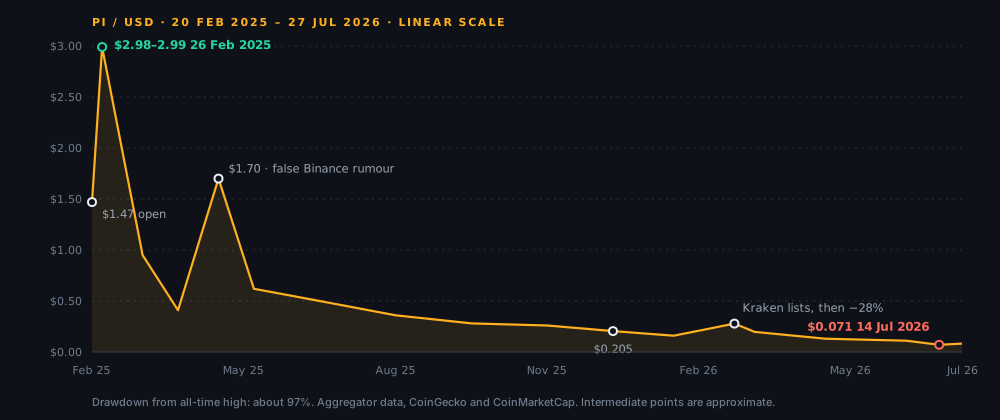
Every Pi Coin price you read is three things at once: a number, the set of venues it was averaged from, and a timestamp. Drop any of the three and it stops meaning anything. That is why Pi prices get misreported more than almost any comparable asset. Two major aggregators disagree about Pi's total supply by a factor of six. Three trackers place its all-time low on three different days. An exchange once cashed out holders of something called PI at forty-two times the price real PI opened at a week later.
So this page does not tell you what Pi will be worth. No targets, no forecasts, no ranges. Instead we take the quote apart: where it comes from, what sits under the market cap, why the supply denominator changes the answer, and how thin the book gets when you try to sell into it.
The snapshot, and its expiry date
As of 27 July 2026, Pi Coin traded at roughly $0.0819 — $0.08188 on CoinMarketCap, $0.08184 on CoinGecko. Agreement to four decimals is itself a finding: this market is thin, but not fragmented. Market capitalisation sat near $896 million on about 10.94 billion circulating PI, or 10.94% of the fixed 100 billion maximum. Twenty-four-hour volume came in anywhere between $7.9 million and $12.3 million depending on whom you asked.
That paragraph began decaying as it was written. For a current price use CoinGecko's pi-network page or CoinMarketCap, then confirm it against the order book on the venue you would trade on.
Pi Coin market snapshot — 27 July 2026, aggregator data
- Price
- ≈$0.0819; CoinGecko's 24-hour range $0.08088–$0.08346. Market cap ≈$896m — circulating supply × price, nothing more.
- Circulating supply
- ≈10.94bn PI, rising monthly. Pi's MiCA white paper cited approximately 8.2 billion as of October 2025; no current official figure exists. Do not subtract the two and read the difference as unlocks: the ~1.21 billion of 2026 unlocks below releases Pi that was already mined and locked, whereas the circulating figure also absorbs migrations of previously mined balances onto the chain. They count different things and will not reconcile.
- Max supply
- 100,000,000,000 PI — confirmed on-chain as
total_coinsin the mainnet ledger header. - All-time high
- $2.99 on 26 February 2025 (CoinGecko); $2.98 per CoinMarketCap.
- All-time low
- ≈$0.071 in mid-July 2026 — $0.07059 and $0.07072 dated 14 July; CoinCodex logs $0.07316 on 16–17 July.
- Where it trades
- Entirely on centralised exchanges. Pi's mainnet Horizon API returns zero liquidity pools and zero trades, ever.
Why three sites show three different Pi prices
Aggregator prices are volume-weighted averages, so the answer depends on which markets were included. Pi makes that choice unusually consequential: its liquidity is scattered across mid-tier venues, some of which trade an IOU rather than the real coin.
The clean example on 27 July 2026 is volume. Same asset, same day, three totals: $7.88m (CoinMarketCap), $8.53m (CoinGecko), $12.29m (CoinCodex, across 22 exchanges and 32 pairs). A spread about 56%, on a figure countless articles quote to two decimals as though it were measured. Three mechanisms produce it: different venue constituents, IOU markets counted in or left out, and rolling 24-hour windows that do not close at the same second. CoinGecko, for instance, keeps pi-network and pi-network-iou as separate assets, with Hotcoin alone carrying about 97% of the IOU side's volume.
| Metric | CoinMarketCap | CoinGecko | CoinCodex |
|---|---|---|---|
| Price | $0.08188 | $0.08184 | Same level |
| Market cap | $895.99m | $895.83m | — |
| 24h volume | $7.88m | $8.53m | $12.29m |
| Circulating supply | 10.94bn | 10.942bn | — |
| Total supply used | 100bn | 16.833bn | — |
| FDV | $8.18bn | $1.378bn | — |
| All-time high | $2.98 | $2.99 | — |
| All-time low | $0.07072, 14 Jul | $0.07059, 14 Jul | $0.07316, 16–17 Jul |
| Markets counted | Not stated | 18 via API | 22 exchanges |
None of the three is wrong. They are differently scoped. The rule follows directly, and we apply it to ourselves: name the source beside the number, every time. A Pi figure with no attribution and no date is a rumour with a decimal point.
The full Pi price record, with the disagreements left in
Pi has traded on open markets since 20 February 2025 at 08:00 UTC, when the Open Network removed the firewall that had made external transfers impossible. Seventeen months is a short record, but nearly every large move has a mechanical cause.
-
20 Feb 2025
First real price: about $1.47
PI/USDT opened on OKX near $1.47, spiked toward $2.10 within hours, closed near $1.01 as migrated tokens met the bid. One outlet dates the launch to 19 February; OKX's notice says the 20th.
-
26 Feb 2025
All-time high: $2.98 or $2.99
CoinMarketCap records $2.98, CoinGecko $2.99. FDV at the peak was reported above $25 billion as listings cascaded. Never revisited.
-
Apr 2025
Down to roughly $0.41
The weakest-sourced stretch of the record: no primary 2025 OHLC table could be retrieved, and secondary sources disagree.
-
May 2025
A false Binance rumour takes PI past $1.70
Listing speculation drove the price above $1.70. The rumour was false and the move unwound completely.
-
31 Dec 2025
Year closes near $0.205
Sources give $0.2045 and $0.2048. December alone saw roughly 190 million π unlock against an estimated 11–12% monthly decline.
-
13 Mar 2026
Kraken lists: +30%, then −28% in 24 hours
PI rallied over 30%, then fell 28% within a day from above $0.278 to $0.1969 on volume near $130 million. The cleanest "sell the listing" datapoint in Pi's record, on its most credible venue to date.
-
14 Jul 2026
All-time low around $0.071 — date disputed
CoinGecko logs $0.07059 and CoinMarketCap $0.07072 on 14 July; CoinCodex records $0.07316 on 16–17 July, and one report describes a 17% drop to near $0.076 on the 16th. RSI touched 27, its lowest ever.
-
27 Jul 2026
Roughly $0.0819
About 97.3% below the all-time high, about 16% above the low set two weeks earlier.
We leave the disagreements in because the disagreement is the finding. When three reputable trackers cannot agree on the date of a low that happened a fortnight ago, you have learned something real about how well this market is measured.
Affiliate disclosure: the two buttons above open a third-party exchange in a new tab and are tagged nofollow sponsored. We may earn a commission at no extra cost to you. This is not the official Pi Network app, the official Pi Wallet, or an endorsement — and the PI instrument sold there is an IOU, not native mainnet Pi. Nothing here is financial advice.
The FDV problem: two answers, six times apart
Fully diluted valuation is price multiplied by total supply. The arithmetic is trivial; the denominator is not, and the two mainstream aggregators pick different ones.
CoinMarketCap
Denominator: 100 billion
Total supply treated as max supply — every PI that will ever exist, including tokens not yet mined. FDV near $8.18 billion.
CoinGecko
Denominator: 16.833 billion
Total supply treated as PI already minted — circulating plus locked plus unmigrated. Same price, FDV near $1.378 billion.
Both are defensible; they answer different questions. But the gap is roughly sixfold — the difference between an asset priced like a mid-cap and one priced like a large-cap. Treat any headline quoting "Pi's fully diluted valuation" as unusable unless the denominator is stated in the same breath. A third figure near $1.548 billion also circulates in search results; we could not tie it to a primary page and will not repeat it.
Market cap deserves the same scepticism. Pi's ~$896 million counts only circulating tokens — not locked balances, not unmigrated mobile balances in the app, and not the 20 billion Core Team allocation that, per Pi's whitepaper, releases proportionally as community supply circulates. It prices today's float and says nothing about what is queued behind it.
Unlocks: the structural driver nobody can vote away
The dominant force on Pi's price is arithmetic, not sentiment. Third-party trackers put roughly 1.21 billion π entering circulation across 2026 — about 3.3 million π per day, or roughly $270,000 of new sellable supply daily at the 27 July price. Against $7.9–12.3 million of daily volume that is on the order of 2–3.5% of everything that changes hands, and about 11% annual dilution on a 10.94 billion base. Neither number is catastrophic alone. Together, in a market this thin, they are a headwind no product announcement has yet offset.
The reported monthly pattern for 2026: January ~135 million π (the year's peak; 134m and 136m both circulate), February ~130 million, March ~97 million, April ~85 million, July 103.7 million. Note the last one. The taper is not monotonic — July released more than April, so do not assume unlocks only shrink from here.
What we could not verify about unlocks
We looked for a primary unlock schedule published by the Pi Core Team and found none. Every figure above is third-party derived, typically from dashboards or the mainnet explorer. A widely circulated "775.8 million" supply-expansion figure could not be reconciled with the 1.21 billion annual total at all. Treat these as indicative, never as a schedule.
Liquidity, and the difference between the quote and the price you get
The aggregator number averages trades that already happened. Your price is set by whatever orders sit in the book when yours arrives. Those diverge sharply for Pi, because the book is far thinner than a $896 million market cap suggests.
Daily volume of $8–12 million against that cap is a volume-to-market-cap ratio near 0.9–1.4%. Very thin — a large holder cannot exit anywhere near screen price. Depth is unevenly spread, too. On 27 July 2026 BitMart alone carried roughly 25–39% of tracked PI volume and OKX about another 26% on CoinGecko's baseline, while Kraken — the first genuinely US-regulated venue to list PI — showed PI/USD and PI/EUR turning over roughly $11,500 combined in 24 hours, four months after listing. Tier-1 listings brought Pi legitimacy, not liquidity. Our breakdown of Pi trading platforms goes venue by venue on rails, fees and restrictions.
- The bid-ask spread is an immediate cost. Buy at the ask, sell at the bid, and you pay that gap twice before any fee. On thin PI books it widens exactly when you most want to trade.
- A market order accepts any price. On a shallow book it eats through several price levels and your average fill lands well away from the quote you saw. That gap is
slippage. - A limit order names your price. It cannot fill worse than your number, but it may not fill at all. With Pi's depth profile, that trade-off usually favours the limit order.
- Read the depth, not just the quote — on the venue and pair you would actually use.
Pi's deepest market is closing
BitMart, the venue carrying the largest single share of PI volume, is winding down its whole operation: deposits suspended 26 July 2026, trading ending 26 August 2026, operations ceasing 31 January 2027, per BitMart's own notices. It never enabled a native PI deposit or withdrawal rail either — its PI notice still reads "TBD". So between a quarter and two-fifths of Pi's reported liquidity was never withdrawable liquidity, and it is about to vanish from the totals. Any volume or depth figure that includes BitMart, including the ones on this page, needs re-baselining after 26 August 2026.
The IOU price trap: same ticker, different asset
The most expensive way to misread a Pi price is to read the price of something that is not Pi. An IOU is an exchange-internal claim: the venue credits your account with a balance labelled PI and you trade it against other users there. No blockchain transaction sits behind it, deposits and withdrawals are disabled by definition, and your counterparty is the exchange. CoinGecko's own note is that IOUs "may not be transferable across exchanges."
Because the rails are shut, the arbitrage channel that normally pins a derivative to its underlying does not exist. Nobody can buy real PI elsewhere and deliver it into the IOU market. Demand is captive, and the float is whatever the exchange's ledger says.
An exchange once priced PI at 61.28 USDT
HTX opened a PI/USDT IOU market on 29 December 2022, saying deposits and withdrawals would open once the mainnet upgraded. On 13 February 2025 at 08:00 UTC it delisted the IOU and force-converted every holder's balance at 1 PI = 61.28 USDT. Seven days later real PI opened near $1.47 — so the IOU had traded at about 42 times the real launch price, and around 20 times the highest price real Pi has ever reached. Nobody chose that exit; the exchange set it.
The confusion is still live: Bitget hosts two PI pages at once — an informational "Pi [IOU]" entry marked "Not listed", plus its actual native PI market — and search indexes have surfaced them at prices roughly 41% apart. The reliable test is never the ticker or the page title. It is whether the venue lets you withdraw PI to a Pi mainnet G… address you control.
As of 27 July 2026 the IOU price tracked native spot almost exactly, near $0.0819, because a real reference price now exists to anchor it. That is a feature of the moment, not a property of IOUs. Which venues run which kind of market keeps changing, so check before funding: our Pi Coin exchange audit tracks native versus IOU status venue by venue, and where to buy Pi Coin covers regional access. To hold rather than trade, read the Pi Wallet guide first.
What has actually moved the Pi price
Four kinds of event account for nearly every large move. None is a chart pattern.
Listings, and the sell-the-listing pattern
Kraken on 13 March 2026 is the textbook case: over 30% up into the event, then 28% down within a day. The February 2025 launch cascade did the same at larger scale. Analyst targets of $0.50–$0.75 circulated ahead of Pi Day 2026 and did not materialise. A listing adds a venue, not a buyer.
Unlocks
December 2025's roughly 190 million π release coincided with an estimated 11–12% monthly decline. July 2026's 103.7 million accompanied a 17% single-day drop on the 16th and that week's all-time low. Correlation is not proof, but the mechanism is not mysterious: supply arrives on a schedule, demand does not.
Rumours, in both directions
The May 2025 Binance rumour pushed PI above $1.70 and then gave all of it back. Late August 2025 ran the other way: claims that OKX would suspend PI margin borrowing and delist entirely by 27–28 August, with MEXC following. It was debunked, no pairs were removed, and OKX still trades PI today — yet one outlet published the delisting as fact. That is the best single illustration of why Pi coverage should be treated as stale or unsourced by default. Even Binance's February 2025 vote-to-list, which passed with roughly 86% support on between 226,000 and 295,000 votes depending on the report, became a sell catalyst when it closed and nothing happened: PI fell about 20% to around $2.15.
Security incidents
On 30 December 2025 the Core Team suspended the wallet's payment-request feature after a social-engineering campaign drained more than 4.4 million π. The chain behaved as designed; the failure was human.
Why we publish no Pi price prediction
Because it would be a guess wearing the costume of research, and you would be the one acting on it.
Consider what a credible forecast needs here: a reliable volume figure (aggregators differ by 56%), a settled supply denominator (they differ sixfold), a primary unlock schedule (none is published), and a market whose largest venue is not shutting down mid-year. None of those holds. Add that Pi's own MiCA white paper, filed October 2025, states plainly that the asset "may lose its value in part or in full, may not always be transferable and may not be liquid." When the issuer's legal disclosure reads like that, a twelve-month target from a content site is not analysis. It is advertising inventory.
You will still meet predictions everywhere. Read them like this:
- No stated method. A 2027 number with no supply, volume or adoption assumption behind it came from no model.
- Wide ranges dressed as precision. "$0.15 to $2.50" is not a forecast, it is a hedge that cannot be wrong.
- Stale inputs. Articles describing PI as trading "around $0.12 to $0.14 in 2026" were right earlier that year and wrong by late July.
- Affiliate alignment. A bullish target beside a sign-up link is marketing with a chart attached. This site runs affiliate buttons too — which is exactly why no numbers are attached to them.
- Indicators as prophecy. Pi's RSI hit 27 in July 2026, its lowest since launch. That describes what happened; it forecasts nothing.
How to check a live Pi Coin price properly
Four minutes, in this order, every time.
- Read two aggregators, not one. CoinGecko and CoinMarketCap side by side. Note the volume spread rather than picking the flattering number.
- Confirm you are on the native asset. On CoinGecko,
pi-networkis the real coin andpi-network-iouis not. Check the slug in the URL, not the heading. - Open the order book on your own venue. The aggregator average is not your fill price. See how fast the book thins either side of the quote.
- Check the withdrawal rail before the price. Confirm the venue supports native PI withdrawals to a
G…address, and whether it requires a memo. Several venues with active PI markets have no working on-chain rail at all. - Date-stamp whatever you write down, including anything copied from this page.
The short version
PI traded around $0.0819 on 27 July 2026 — roughly 97% below its February 2025 high, about 16% above the low set two weeks earlier, on $8–12 million of daily volume against a $896 million market cap. Every one of those numbers needs a source name and a date attached. Two aggregators disagree sixfold on the supply figure behind FDV, three disagree on when the all-time low happened, and roughly 3.3 million π keeps arriving daily on a schedule nobody publishes officially. That is not a price you forecast. It is a price you check twice, on the venue you can actually withdraw from.
Frequently asked questions
What is the Pi Coin price today?
On 27 July 2026 PI traded at roughly $0.0819 — $0.08188 on CoinMarketCap and $0.08184 on CoinGecko — for a market capitalisation near $896 million on about 10.94 billion circulating tokens. That figure decays within minutes, so treat it as a dated reading rather than a current quote. Check CoinGecko or CoinMarketCap directly, then cross-check one exchange order book before acting on any number.
Why do CoinMarketCap, CoinGecko and CoinCodex show different Pi prices and volumes?
Because they average different sets of venues. On 27 July 2026 the three prices agreed to within a fraction of a cent, but 24-hour volume came in at $7.88 million, $8.53 million and $12.29 million respectively — a spread about 56%. Aggregators include or exclude different exchanges, treat IOU markets differently, and close their rolling 24-hour windows at different moments. Volume is the least reliable Pi figure published anywhere.
What is Pi Coin's all-time high and all-time low?
The all-time high was set on 26 February 2025: $2.99 per CoinGecko, $2.98 per CoinMarketCap. The all-time low is around $0.071, reached in mid-July 2026 — CoinGecko records $0.07059 and CoinMarketCap $0.07072, both on 14 July, while CoinCodex records $0.07316 on 16–17 July. That disagreement comes from different venue sets and different day boundaries, not from anyone being dishonest.
What is Pi Coin's fully diluted valuation?
There is no single answer, and that is the honest reply. CoinMarketCap multiplies price by the 100 billion max supply, giving roughly $8.18 billion. CoinGecko multiplies by the roughly 16.833 billion tokens minted to date, giving roughly $1.378 billion. Both are internally consistent and they differ by about six times. Any source quoting "Pi's FDV" without naming its denominator is telling you nothing usable.
How much Pi is unlocking in 2026, and does it affect the price?
Third-party trackers put roughly 1.21 billion π entering circulation across 2026, around 3.3 million π per day, or about $270,000 of new supply daily at July 2026 prices. Against daily traded volume of $8–12 million that is mechanically significant. We could not locate any primary Pi Core Team unlock schedule, so every monthly figure you see, including ours, is a third-party estimate.
Can a PI price be for a different asset than the one I want to buy?
Yes, and it has happened at extreme scale. HTX ran a PI IOU that was force-converted at 1 PI = 61.28 USDT on 13 February 2025 — roughly 42 times the $1.47 at which real PI opened seven days later. IOUs carry the same ticker with no blockchain behind them. The reliable test is whether the venue lets you withdraw PI to a Pi mainnet G… address you control.
Does Pi Compass publish a Pi Coin price prediction?
No, and we will not. Nobody can forecast an asset this thinly traded, and a target number invites you to act on a stranger's guess. Pi's own MiCA white paper states that the asset "may lose its value in part or in full, may not always be transferable and may not be liquid." When the issuer's regulatory filing says that, a twelve-month target from a content farm is not analysis.
Is the Pi price shown on Binance or Coinbase real?
Those pages are informational feeds, not markets. Neither Binance nor Coinbase listed PI as of 27 July 2026 — Coinbase's asset page is even titled "Pi [IOU]", and Coinbase's own product API returns no PI trading pair. A price page reflects aggregator data the venue does not trade against. If you cannot place an order, the number is not a quote.