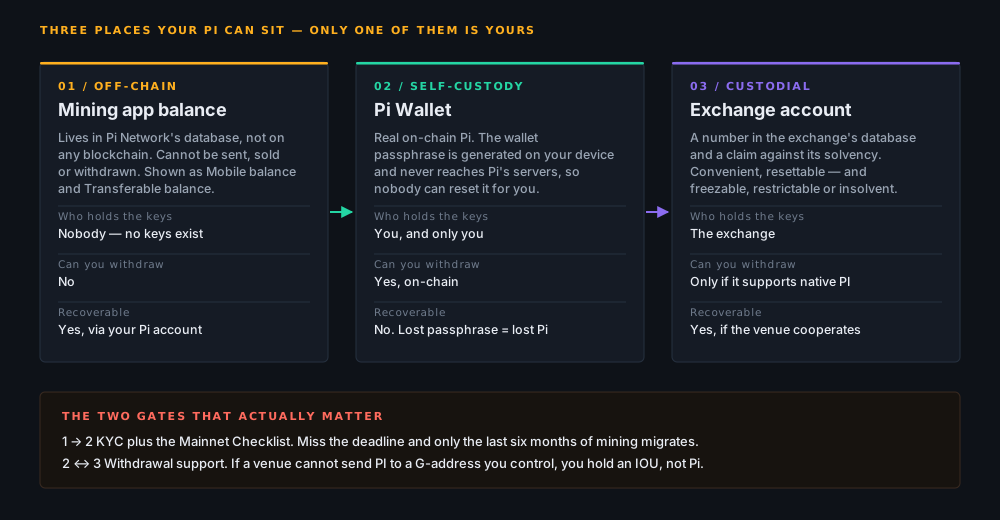
Where to buy Pi Coin has an unsatisfying answer, so here it is in one paragraph. A handful of mid-tier offshore exchanges carry almost all the liquidity, and they quote PI against USDT rather than against money. A short list of regulated venues — Kraken, OKX's licensed EU entity and Bitpanda — carries the credibility and almost none of the volume. The largest consumer platforms, Binance, Coinbase, Robinhood, Crypto.com and Gemini, do not list it at all; we queried their own public instrument endpoints on 27 July 2026 and PI appears in none of them. So your real choice is between depth and protection, and you will not get both.
That is why this page is not another table of exchange logos. The venue-by-venue audit, including the native-versus-IOU withdrawal test and the published fee schedules, lives on our Pi Coin exchange audit. What follows is organised the other way round: by what you are holding, where you are sitting, and what you plan to do with the Pi once you own it. Those three answers determine your route far more than any venue ranking does.
One framing fact before the detail. Total PI turnover on 27 July 2026 was somewhere between $7.88 million (CoinMarketCap) and $12.29 million (CoinCodex), against a market capitalisation near $896 million. Aggregators disagree by roughly 56% because they include different venues and treat IOU markets differently. In a market that thin, the size of your order matters more than the fee schedule.
The short answer, up front
If you already hold USDT on an exchange with a working PI rail, buy there — that is where the book is. If you hold dollars or euros and want a regulated counterparty, Kraken works but its two fiat pairs together traded about $11,500 in 24 hours four months after listing, and its order minimum is 40 PI. If you hold anything else, you are doing two conversions.
Where these numbers come from
Pair listings, deposit and withdrawal status, fees and minimums were read from each exchange's own public REST endpoint on 27 July 2026 — the same configuration that populates their live withdrawal screens. Volume shares come from CoinGecko, CoinMarketCap, CoinCodex and LiveCoinWatch. The list of KYB-verified businesses is published by Pi Network at minepi.com/kyb-list. EU intentions are quoted from Pi's MiCA white paper of October 2025.
Decide what you are optimising for
For most assets these four goals point at the same exchange. For Pi they pull apart hard, and choosing without noticing is how people end up holding a balance they cannot move.
Liquidity and tight spreads
Points you offshore, at USDT pairs on venues like OKX, Gate and Bitget. The catch is concentration: BitMart alone carried between a quarter and two-fifths of tracked PI volume, and it is closing. Once it goes, PI's book is measurably shallower than the volume figures you are reading today suggest.
Regulatory recourse
Points you at Kraken, at OKX's licensed EU entity, or at Bitpanda, which is MiCA-licensed by the Austrian FMA and prices PI in twelve currencies. You get a supervised counterparty and a complaints route. You also get order books an order of magnitude thinner than the offshore venues.
Buying with your own currency
Points at a very short list. Direct exchange fiat pairs for PI exist in US dollars, euros, Turkish lira and Brazilian real, and nowhere else at meaningful size. Everyone else pays two spreads. A KYB-verified onramp can compress that into one step, usually at a higher headline cost.
Getting the Pi out
The one people skip, and the one that voids the others. A PI market is not a PI rail. On 27 July 2026 only five exchanges published a working two-way native rail: Kraken, OKX, Bitget, Gate and LBank. If withdrawal matters to you, that list is your shortlist, whatever the volume table says.
Rank those four honestly before you open an account. If your answer is "I want to buy Pi and move it into my own wallet", goal four dominates and roughly three-quarters of the venues quoting a PI price are irrelevant to you. Our Pi Wallet guide covers what receiving it actually involves, including the passphrase you cannot reset.
By quote currency: which pairs actually exist
Start here, because the pair you can trade is decided before you choose a venue. Essentially every PI market on earth is quoted in USDT. The exceptions are few enough to list individually.
- USDT — the default. Present on OKX, Gate, Bitget, MEXC, LBank, XT.COM, CoinW, DigiFinex, BTCC and others. This is where the depth is.
- USD — Kraken quotes PI/USD; OKX's instrument list also carries a live PI-USD pair.
- EUR — Kraken quotes PI/EUR; OKX carries PI-EUR.
- USDC — OKX and MEXC.
- TRY — OKX, the only major Turkish lira pair we could verify.
- BRL — OKX carries a live PI-BRL instrument, which is easy to miss in coverage written from the CoinGecko top-ten view.
- USDE and USD1 — MEXC, alongside its USDT and USDC books. Note these are alternative stablecoins, not dollars in a bank.
- INR — Giottus only, and see the India row below before you touch it.
The practical consequence: if your currency is not on that list, buying PI costs you two spreads and two sets of fees, and the second conversion happens on a book with single-digit-million daily turnover. That is not a rounding error. It is also worth knowing that Kraken's PI pairs carry an order minimum of 40 PI, so very small test trades are not possible there — a real annoyance when the sensible way to verify a rail is to move a trivial amount first.
Affiliate disclosure: the two buttons above open a third-party exchange in a new tab and are tagged nofollow sponsored. We may earn a commission at no extra cost to you. This is not the official Pi Network app, the official Pi Wallet, or an endorsement — and the PI instrument sold there is an IOU, not native mainnet Pi. Nothing here is financial advice.
Where to buy Pi Coin by region
Regional availability is the part of this subject where published information is worst, so the table below marks what we verified and where we could not. Where a cell says we could not confirm, that means not confirmed — not unavailable.
| Region | Documented route | Direct fiat pair | What to know |
|---|---|---|---|
| United States | One verified | USD | Kraken listed PI on 13 March 2026 with PI/USD and PI/EUR; its notice says trading via the Kraken app and Instant Buy would follow "once liquidity conditions are met", so advanced trading only at launch. It does not serve New York or Maine, and PI/EUR is additionally unavailable in Texas and New Hampshire. Reports that OKX opened US access on 21 May 2026 are contradicted by OKX's own US page, which says it "may support Pi Network in the future" — we do not treat OKX US as available. Not Coinbase, not Robinhood, not Gemini, not Crypto.com. See buying Pi in the USA. |
| EU / EEA | Yes | EUR | Pi's MiCA white paper states the intention that Pi be admitted to trading in the EU "initially on the crypto exchange of OKCoin Europe Limited (branded OKX)", which is licensed by the Malta Financial Services Authority. Bitpanda, MiCA-licensed by the Austrian FMA, also prices PI — though its PI deposit and withdrawal support is something we could not verify. A MiCA white paper is filed by the issuer and approved by nobody; the same document warns the asset "may lose its value in part or in full, may not always be transferable and may not be liquid." |
| Turkey | Yes | TRY | OKX runs a live PI/TRY pair — the one genuinely local fiat route outside the dollar, euro and real. Bitpanda also quotes PI in lira. No SPK warning naming Pi Network could be located, which is not the same as approval. |
| Brazil | Partly | BRL | OKX carries a live PI-BRL instrument. Mercado Bitcoin, a regulated Latin American venue, also appears in CoinGecko's PI ticker list, but it is not on Pi's KYB list and we could not verify its rail. |
| India | No real market | INR (nominal) | CoinDCX, WazirX and ZebPay returned zero PI pairs across 1,014, 500 and 515 symbols respectively. Giottus exposes PI/INR and labels it spot in its own API, while CoinGecko classifies it as an IOU with about $134 of 24-hour volume. Read buying Pi in India before committing rupees anywhere. |
| South Korea | No evidence | None found | KRW markets are controlled by FIU-licensed exchanges — Upbit, Bithumb and Coinone as of April 2026. Upbit supported 448 assets in May 2026 and PI is not among any reported listing. We found no evidence of a PI listing on Upbit or Bithumb. Lean no, unconfirmed. |
| Indonesia · Malaysia · Philippines | Thin data | None found | Honestly: our research here is weak. No local licensed venue with a PI pair was verified, and claimed regulator warnings from these markets trace to a single secondary source that garbles the name of the Philippine central bank. Assume the global USDT venues are the route, and assume nothing about local legality. |
| Vietnam | Warned | None found | Hanoi Police's cybercrime division stated on 3 March 2025 that cryptocurrencies including Pi are not legally recognised as assets and that paying with Pi risks fines or prosecution. That is a warning about use, not a listing fact — but it belongs on this page. |
The pattern across the whole table: PI's regulated access is real but narrow, its local-currency access is almost nonexistent, and its liquid access sits on venues nobody's regulator supervises. Coverage of Pi is also unusually stale — OKX's own FAQ text still said PI "isn't available to buy or trade on crypto exchanges" on a page listing live PI pairs. Check the venue, not the article.
Fiat onramps as an alternative route
An onramp is not an exchange. An exchange matches you against other traders on an order book, and you pay a maker or taker fee plus the spread you cross. An onramp sells you crypto as a product: you hand a card or bank payment to a payment provider, it sources the asset and delivers it, and it prices the whole package. There is no order book you can inspect, which is exactly why the cost is usually higher — the margin is inside the quote rather than printed on a fee page.
For Pi specifically, the relevant filter is Pi Network's own KYB list, which names three on- and off-ramps — Onramp.money, Onramper and Banxa — plus TransFi and Zypto under a separate “other services” heading. Pi states that only KYB-verified businesses can hold Pi Mainnet wallets, which is what makes direct delivery to a mainnet address technically possible at all. It also states plainly that Pioneers should refrain from using third-party services claiming Pi integration that are not on that page.
Banxa's role changed in July 2026
Banxa used to appear inside the Pi app's mainnet-wallet-creation flow, and Wallet Activation in May 2025 explicitly let Banxa-verified non-Pioneers activate a mainnet wallet. Since the July 2026 app update, Banxa was removed from that in-app flow in favour of Fast Track KYC. Banxa remains a KYB-verified third-party service where supported. If a guide tells you to create your wallet through Banxa, it is describing a flow that no longer exists.
Two cautions. First, KYB verification says a business passed Pi's identity check; it says nothing about price, coverage or service quality. Second, onramp availability is decided by your country and payment method, and it changes without announcement. Get a live quote and compare the all-in delivered amount of PI against what the same money would buy on an exchange, including the withdrawal fee. Sometimes the onramp wins on convenience alone. Our step-by-step buying and selling guide walks the mechanics of both routes.
Peer-to-peer and in-person trades
People reach for P2P when their region has no pair, and it is the single worst-value decision on this page. Not because Pi is unusual, but because Pi has none of the machinery that makes P2P survivable elsewhere.
There is no escrow, so there is no recourse
Pi settles on a Stellar-derived chain: transactions are final in roughly five seconds and cannot be reversed, and there is no escrow contract layer in use — Pi's mainnet has never had a single issued asset, liquidity pool or on-chain trade. If you pay first, you are relying entirely on a stranger's goodwill. If you send Pi first, the same is true in reverse. The classic version is "I already sent it, check again in an hour", repeated until you stop replying.
Two Pi-specific aggravations. The mainnet Horizon API is public and unauthenticated, so anyone can look up how much PI an address holds before choosing a target — wallet privacy on Pi is effectively zero. And in December 2025 the Core Team suspended the wallet's payment-request feature after attackers scanned the chain for large balances and social-engineered approvals, draining over 4.4 million PI. Pi's position was that users lost funds by approving requests themselves. That is legally tidy and financially cold.
Pi's community commerce is often offered as evidence that P2P is normal and safe here. It is not evidence of that. Pi reported more than 125,000 registered sellers during PiFest with about 58,000 active, and those are real merchants accepting Pi for goods. A merchant taking Pi at a stall is a small, repeated, reputation-bound transaction. Wiring a stranger four figures against a promise is not the same activity, and the existence of the first does not make the second safe.
Places you should not buy Pi
Each of these is a real, documented pattern rather than a hypothetical.
- Any venue not on Pi's KYB list, if you intend to withdraw. The KYB list names seven exchanges: Kraken, OKX, Bitget, Gate.io, Pionex, LBank and MEXC. Two caveats on that list if withdrawing is the point: Pionex appears on CoinGecko's IOU side, and MEXC's rail could not be confirmed as still live — the rails we could verify are Kraken, OKX, Bitget, Gate and LBank. Everything else is outside Pi's sanctioned set — including BitMart, which carried Pi's largest market and never enabled a native rail.
- Anything that asks for your wallet passphrase. Pi's own rule: do not enter it anywhere that is not exactly
wallet.pinet.comin the Pi Browser. No exchange, onramp or broker needs it. A request for it is a theft in progress. - Any "PI" with a contract address. Pi mainnet hosts zero issued assets, so wrapped PI cannot exist there. KuCoin hosts a page for "Pi Network DeFi", an unaffiliated BEP-20 token on BNB Smart Chain at
0x746760ec…— and KuCoin's own API returns "PI currency does not exist" for real Pi. - The wrong dropdown entry on a multi-chain venue. XT.COM's withdrawal config exposes three wrapped PI chains — its own smart chain, BNB Smart Chain and Ethereum — beside native PI, with wildly different fees. Picking the wrong one sends an unaffiliated token to a
0xaddress. CoinW carries three confusable PI-named assets; Toobit's coin idPIis an unrelated Polygon token. - Impostor listings on retail apps. A CoinSwitch web3 listing points at a Solana pump.fun token named "Pi NetWork". It is not Pi.
- Telegram and WhatsApp brokers. Unsolicited "OTC desks" offering below-market Pi are the delivery mechanism for the P2P failure above, with an added layer of impersonation — the Core Team has stated no team member will ever contact you individually about authentication.
- Inflated-value lures. Bitdefender documented 140+ Facebook ad variations in June 2025 harvesting recovery phrases to "claim 628 Pi" and pushing fake mining installers carrying malware. Related fabrications include a fictional $310,000 per Pi "consensus value" and a "1 Pi = $314" claim. We should be precise here: we found no documented "Pi doubling" scheme under that name, and we are not going to invent one. The lure is always an impossible price, not a multiplier.
Check this before you deposit anything
Run this list on the venue's own pages, not on a review site. It takes ten minutes and it is the difference between owning Pi and owning a database row.
- Native withdrawal, confirmed on their withdrawal page. Can you select PI, see a
G…address field, and get a fee quoted? If withdrawals are permanently disabled, that market is an IOU regardless of its label. - Memo requirement. Gate and XT.COM flag PI as requiring a memo or tag; Kraken requires one for
G…destinations; LBank's config says none; Bitget's API says none while its own wiki suggests otherwise. Read the field on the screen in front of you, and never guess. - Region eligibility, before KYC. Neither Kraken nor OKX enumerates restricted states or jurisdictions for PI. Find out whether you are eligible before you hand over documents, not after.
- Withdrawal minimum and fee, at today's price. These are USD-pegged and therefore float. Bitget's PI minimum was about 123.84 PI — roughly $10 — and Kraken charges 3 PI with a 10 PI minimum, while XT.COM's minimum was 1,000 PI. A minimum above your intended purchase means you cannot leave.
- Book depth for your actual size. Look at the order book, not the 24-hour volume. Kraken's PI pairs need 40 PI minimum per order and together turned over about $11,500 a day. A large market order in a book that thin moves the price against you before it fills.
- Deposit network sanity. Kraken's listing notice states it directly: deposits made using other networks will be lost. Pi is not EVM, has no bridge and no contract — there is no second network to choose.
Move a test amount first, and read the memo field
Before you send a real balance anywhere, send the smallest amount the venue permits and confirm it arrives and credits. A Pi transaction is final in about five seconds and cannot be recalled, and a deposit sent without a required memo lands in the exchange's pooled address with nothing to identify it as yours. Recovering that depends entirely on a support queue's goodwill, and sometimes it is not recoverable at all.
Verdict by use case
You hold USDT and want the best fill: the venues whose two-way rails we could verify — OKX, Gate, Bitget and LBank offshore, Kraken onshore. MEXC is KYB-verified and announced both rails in February 2025, but we could not confirm it is still live. Verify the rail, size your order to the book, withdraw promptly.
You hold USD or EUR and want a supervised counterparty: Kraken, or OKX's licensed entity in your jurisdiction. Accept the thin book and the 40 PI order minimum as the price of recourse.
You hold Turkish lira or Brazilian real: OKX has the only direct pairs we could verify. Everyone else converts twice.
You hold rupees, rupiah, ringgit or won: there is no good local answer today. A KYB-verified onramp or a two-step conversion through a stablecoin, with your eyes open about the cost.
You want speed and will pay for it: one of the three KYB-verified on/off-ramps, after comparing the all-in delivered PI against the exchange route.
You want the cheapest possible price: then you want the deepest book, which is offshore, which is the least protected. That trade-off is the entire subject. Anyone who tells you otherwise has not looked at the volume figures.
One closing note that applies to every row above. Pi's own MiCA disclosure says the token may lose its value in part or in full, may not always be transferable, and may not be liquid. That is the issuer's language, not ours, and it is a fair summary of what the market data shows.
Frequently asked questions
What is the simplest way to buy Pi Coin if I hold only my local currency?
Unless your currency is US dollars, euros, Turkish lira or Brazilian real, there is no direct pair, so you will convert twice: local currency into a stablecoin or major fiat, then into PI. You pay a spread on both legs plus any payment fee. Compare that total against a KYB-verified fiat onramp, which does the same two conversions in one step and charges for the convenience.
Can I buy Pi Coin in the United States?
On one venue we can verify, as of 27 July 2026: Kraken, which has listed PI/USD and PI/EUR since 13 March 2026. News reports say OKX opened US access on 21 May 2026, but OKX's own US-locale page simultaneously says it "may support Pi Network in the future, subject to jurisdictional availability", so we do not treat that as settled. Kraken does not serve New York or Maine. Coinbase, Robinhood, Gemini and Crypto.com return zero PI markets on their own APIs.
Is there a PI/EUR pair, and is it MiCA-compliant?
Kraken quotes PI/EUR, and OKX's instrument list includes a live PI-EUR pair. Pi's own MiCA white paper states the intention that Pi be admitted to trading initially on the exchange of OKCoin Europe Limited, branded OKX and licensed by the Malta Financial Services Authority. A MiCA white paper is filed by the issuer, not approved by a regulator, so treat it as a disclosure rather than a seal of approval.
Which exchange has the most Pi Coin liquidity?
On 27 July 2026 BitMart carried the single largest share of tracked PI volume, between a quarter and two-fifths of it, with OKX next at about 26%. That statistic is about to break: BitMart suspended deposits on 26 July 2026, ends trading on 26 August 2026 and closes entirely on 31 January 2027. It also never enabled a native PI deposit or withdrawal rail, so its liquidity was never withdrawable.
Do fiat onramps let me buy Pi directly into my Pi Wallet?
Pi's KYB list names three on/off-ramps — Onramp.money, Onramper and Banxa — plus TransFi and Zypto under its separate “other services” heading. Being KYB-verified means the business is permitted to hold a Pi Mainnet wallet, which is what makes a direct-to-wallet delivery technically possible. It is not a price guarantee, a service guarantee or an endorsement, and coverage varies sharply by country and payment method.
Why can I not buy Pi Coin on Binance or Coinbase?
Neither has ever listed it. Binance returned zero PI symbols out of 3,659 when we queried its public exchange-info endpoint, and Coinbase returned zero of 831 products. Binance ran a community vote-to-list in February 2025 that passed with roughly 86% support and then did nothing with it. Reported blockers include closed source code, limited audit visibility and regulatory uncertainty about PI's status — not lack of demand.
Is a P2P trade cheaper than using an exchange?
Sometimes on paper, never once you price the risk. Pi settles on a Stellar-derived chain with irreversible transactions and no escrow layer, so a counterparty who receives your payment and does not send the Pi cannot be forced to. The Pi blockchain's Horizon API is public and unauthenticated, which means anyone can see how much you hold before deciding whether to approach you.
How do I know a venue can actually pay me out in native Pi?
Check the withdrawal page before you fund the account. As of 27 July 2026 only five exchanges published a working two-way native PI rail in their own APIs: Kraken, OKX, Bitget, Gate and LBank. XT.COM allows withdrawals but has deposits disabled. HTX, BitMart, DigiFinex, CoinW, WEEX and Coinstore list a PI market with no functioning on-chain rail at all — HTX's symbol is a leftover from the IOU it force-converted in February 2025, with an empty chain list, so it never became a native market.